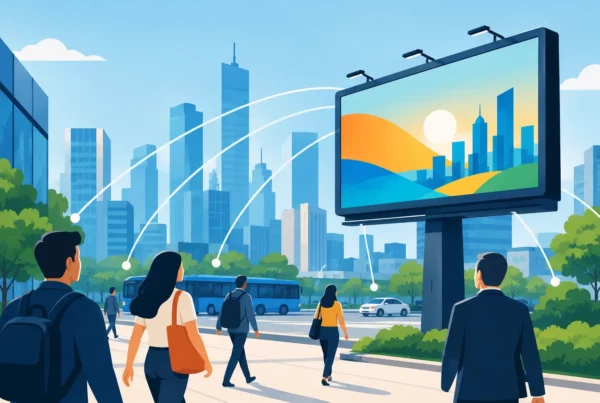

A commuter may pass the same billboard 10, 20, or 40 times in a month. That repetition is what makes the best billboard locations for commuters so valuable. Instead of relying on a single click or a brief social impression, a well-placed billboard puts your business in front of local drivers during the routines that shape where they shop, eat, book appointments, and spend their money.
For Central Florida businesses, commuter advertising is not simply about choosing the road with the biggest traffic count. The strongest campaign matches the audience, direction of travel, time of day, and distance from your location. A billboard on a packed freeway can create broad regional awareness. A display near an exit, business district, or retail corridor can help turn that awareness into action.
What Makes a Commuter Billboard Location Work?
Daily travel creates frequency, and frequency builds recall. When drivers repeatedly see a clear message on the way to work, school, appointments, or home, your brand becomes familiar before they need your product or service. That is especially useful for businesses with longer buying cycles, including healthcare providers, home services, auto dealerships, attorneys, financial institutions, and higher education.
Traffic volume matters, but it should not be the only factor. A location with slightly fewer cars may deliver better results if it reaches the right consumers at a point when they can act. For example, a restaurant near a homebound route may benefit from afternoon visibility, while a medical practice may want to reach drivers headed toward a major employment center in the morning.
The best placements also give drivers enough time to see and understand the message. Congested roadways, signalized intersections, and approaches to interchanges can be highly effective because traffic naturally slows. Faster highway locations can deliver exceptional reach, but creative must be even simpler: one core benefit, a recognizable brand, and an easy next step.
Best Billboard Locations for Commuters by Route Type
Major Interstate Corridors
Interstates are the foundation of many Central Florida commuter campaigns. I-4, I-75, Florida’s Turnpike, and the corridors connecting Orlando with Lakeland, Davenport, Winter Haven, Ocala, and surrounding communities carry large audiences moving between home, work, retail, and entertainment destinations.
An interstate billboard is a strong choice when your goal is market-wide visibility. It can put a regional brand in front of commuters from multiple communities while generating the kind of repeated exposure that supports broad recognition. These locations are particularly effective for franchises, destination businesses, major retail centers, healthcare systems, and brands expanding into a new service area.
Direction matters. A westbound board and an eastbound board do not reach the same audience at the same moment. Morning and evening commute patterns should influence your decision. If your customers live in one community and work in another, the homebound direction may offer the better opportunity to promote dinner, errands, home improvement, or appointment scheduling.
Highway Interchanges and Exit Approaches
Interchanges combine heavy traffic with intent. Drivers approaching an exit are actively making decisions about where to stop, shop, fuel up, or seek services. For businesses close to the roadway, this can be one of the most productive billboard environments available.
The ideal distance depends on what you are promoting. A hotel, restaurant, urgent care center, or retailer may benefit from a board positioned early enough for drivers to prepare for the exit. A brand building general awareness can use interchange inventory farther upstream, where the message has time to register without demanding immediate action.
Keep the creative tied to the location when proximity is a real advantage. A concise message such as “Next Exit,” “Minutes Away,” or “Serving [Community]” can work well when it is accurate and easy to process. Do not overcrowd the board with turn-by-turn directions. Commuters need a reason to remember you, not a map they cannot safely read.
Employment Centers and Office Routes
Roads leading into major employment centers offer access to a dependable weekday audience. These routes can be especially valuable for businesses seeking professionals, families, and established local consumers with predictable travel patterns.
Morning traffic is often ideal for messages that support future planning: banking, insurance, legal services, elective healthcare, home services, and career education. Afternoon placements may be better for businesses that solve immediate needs, including restaurants, grocery stores, fitness centers, childcare, and retail.
The trade-off is that office-route traffic can be less useful on weekends or holidays. If your business depends on seven-day consumer activity, pair an employment-center location with a broader retail, recreation, or residential commuter corridor. A balanced campaign reaches people where they work and where they make household decisions.
Residential Growth Corridors
Fast-growing communities create some of the most attractive opportunities for commuter billboard advertising. In and around Davenport, Winter Haven, Lakeland, Ocala, Sebring, and the greater Orlando area, expanding residential areas often produce substantial daily movement toward job centers, schools, shopping districts, and major roadways.
These routes are a smart fit for brands that serve households: HVAC companies, roofing contractors, real estate professionals, dental practices, home builders, internet providers, local retailers, and family-focused services. Repeated exposure along the route home can make your business the familiar choice when a need arises.
Look beyond population growth alone. Ask where residents are traveling, whether they pass retail clusters, and which direction carries the heaviest weekday flow. A growing neighborhood without a strong commuter route may not provide the frequency you need. The right corridor is one that connects homes with the places residents visit again and again.
Retail and Entertainment Connectors
Some commuter trips blend work, errands, dining, and recreation. Roads connecting major neighborhoods to shopping districts, tourism areas, entertainment destinations, and sports venues can reach consumers when they are already in a spending mindset.
These placements are powerful for businesses that want broad local awareness and weekend relevance. They can also complement an interstate campaign by adding visibility closer to the point of purchase. If a driver sees your brand on I-4 all week and again near a retail destination on Saturday, your message has a much better chance of sticking.
How to Choose the Right Side of the Road
The side of the road is not a minor production detail. It changes who sees the billboard, when they see it, and how well the message performs. Start with the customer journey. Are you trying to reach commuters leaving home, arriving at work, running errands after work, or returning to their neighborhood?
Then consider visibility conditions. A display should have a clear approach, minimal visual competition, and enough viewing time to communicate its message. Nearby trees, new construction, lane shifts, competing signage, and the angle of the face can all affect real-world performance. This is why a location review should go beyond an audience estimate.
For local businesses, proximity can outweigh raw impressions. A billboard that reaches fewer people but sits directly on the route to your store, office, or service area may generate more qualified awareness than a high-volume location across the market. For regional brands, scale and consistency across several routes may be the stronger play.
Match Creative to the Commuter Moment
Commuters do not have time to decode complicated advertising. Your billboard needs a message that can be absorbed in seconds. Lead with a compelling benefit, use a large brand identifier, and limit the message to the essentials. If a phone number, web address, or offer is necessary, make it secondary to the main idea.
Digital billboards offer flexibility for businesses that want to tailor messaging by daypart, promote timely offers, or rotate multiple messages. Static billboards provide uninterrupted, always-on exposure and can create a commanding presence on a key route. Neither format automatically wins. The right choice depends on campaign timing, budget, available inventory, and whether your message benefits from change or consistency.
A strong commuter campaign often works best as part of a wider media plan. Billboards build recognition at scale, while search, social, radio, direct mail, and in-store efforts can reinforce the same message. When a customer encounters your brand across multiple channels, the billboard helps make every other touchpoint more credible and familiar.
Build a Central Florida Commuter Strategy That Fits
The right commuter billboard plan begins with practical questions: Who needs to see your message? Where do they live and work? Which direction do they travel? What action do you want them to take, and how quickly can they take it?
Orlando Outdoor helps businesses answer those questions with strategically located static and digital inventory across Central Florida, plus in-house creative, production, placement, and campaign management. That full-service approach keeps the process focused on business results rather than the complexity of buying a billboard.
Your next customer is already traveling a familiar route. Put a clear, memorable message in that routine, and give them a reason to think of your business before they need it.